"We're talking about a fundamental threat to our whole system of home ownership." That's how Oregon state senator Jeff Golden described the wildfire insurance problem in his home region this spring, after a bill he sponsored to fix part of it died in committee. Golden represents Ashland. He has watched the Rogue Valley rebuild since the Almeda Fire tore through Talent in September 2020. His bill would have closed a specific gap that matters right now to anyone weighing a purchase in Talent: the gap between how safe a rebuilt home actually is and how an insurance policy prices that safety.
If you're comparing a home built after the 2020 Almeda Fire to an older home a few blocks over in Talent, the assumption is usually backwards. People hear "rebuilt after a wildfire" and think liability. The construction record says the opposite. But the insurance system that should reward that difference isn't required to yet, and that's the friction a buyer needs to understand before writing an offer.
The Houses That Went Up Better Than the Ones That Burned
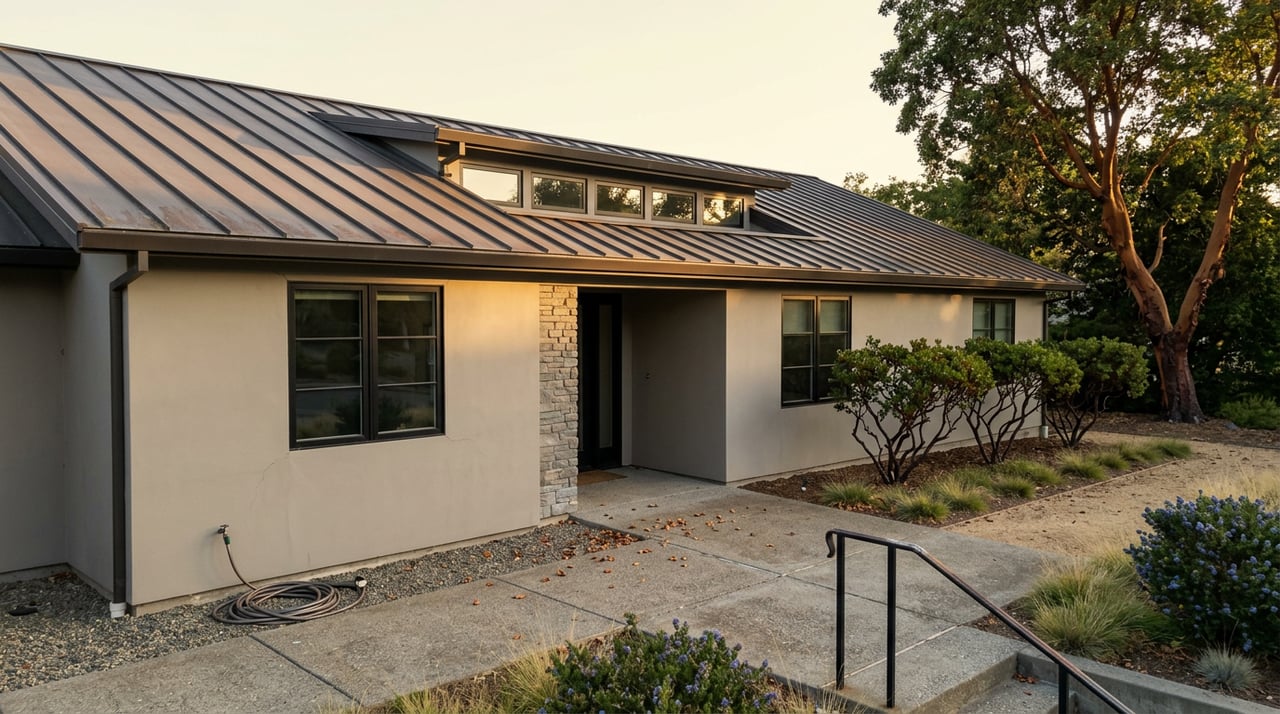
Carole and Alan Balzer lost their Talent home in the Almeda Fire. Their new one, built on the same lot, was the first rebuild completed in the fire zone. It's also, according to reporting from Canary Media, among the most energy-efficient homes in the country, and the efficiency and the fire resistance are the same feature, not two separate upgrades.
The builder was Suncrest Homes, a company that has worked in Ashland and Talent since the early 1990s. Its owner, Charlie Hamilton, told Canary Media his crews essentially stopped taking on any project that wasn't a fire rebuild for two years after 2020. As of early 2026, Suncrest had used boosted energy incentives on all 35 of the homes it rebuilt in the fire zone, which meant triple-pane windows instead of double-pane, exterior rigid insulation, and unvented attics. Triple-pane glass runs about 40 percent more efficient than double-pane and is more likely to stay intact when radiant heat hits it during a wildfire. Windows account for roughly half the heat loss in a typical home, so the upgrade that lowers a utility bill is the same upgrade that keeps embers from finding a way in.
The Balzers went further on their own. Their backyard is landscaped with native plants and a stormwater swale, and they deliberately kept vegetation away from the house walls, a firewise habit that costs nothing but attention.
None of this is marketing language. It's what got built, county by county, permit by permit, across the part of Talent that burned. A rebuilt home there isn't a compromise. In several measurable ways, it's a better-built house than what stood on the lot before.
What Oregon Law Already Guarantees You
Two protections are already on the books, and they matter regardless of which side of the fire line a Talent property sits on.
- An insurer cannot cancel your policy, refuse to renew it, or raise your premium based on a wildfire risk map published by a state agency. That's the rule under ORS 742.278, and it exists specifically because Oregon's earlier statewide wildfire risk map drew so much anger from homeowners that lawmakers pulled it back.
- If an insurer does cancel, decline to renew, or raise your rate for reasons related to wildfire risk, the company has to tell you that wildfire risk was the reason. That disclosure requirement comes from ORS 742.277.
Those two rules protect you from being blindsided by a state map. They do not require an insurer to use your fire-resistant windows, your defensible space, or your unvented attic to lower what you pay.
The Guarantee That Didn't Survive the Session
That's what Golden's bill, Senate Bill 1540, was supposed to fix. It would have required insurers who use wildfire risk models to set premiums to show that those models actually account for a homeowner's documented mitigation work, things like fire-resistant siding, hardened roofing, and cleared defensible space. If an insurer didn't use that kind of modeling, the bill would have required some discount or incentive anyway for homeowners who could show they'd done the work.
The bill cleared the Senate Committee on Natural Resources and Wildfire on a unanimous vote. It stalled afterward in the Senate Rules Committee and died without a floor vote when the legislature adjourned in March 2026, after the insurance industry raised late objections. Kenton Brine, who leads the Northwest Insurance Council, said the more specific the bill got, the harder it would be for insurers to comply, and that the difficulty would filter back into higher costs. Golden, who isn't seeking reelection, said he hoped someone else would carry the idea forward in 2027, but for now there's no legal requirement forcing a carrier to translate a rebuild's hardening features into a lower premium.
Here's the plain version of where that leaves a Talent buyer:
| Already Oregon law | Not required (as of 2026) |
|---|---|
| Insurer can't cancel or raise rates based on a state wildfire risk map (ORS 742.278) | Insurer isn't required to discount premiums for documented fire hardening or defensible space |
| Insurer must disclose when wildfire risk drives a cancellation, nonrenewal, or rate hike (ORS 742.277) | Insurer isn't required to use a mitigation-aware model when pricing a wildfire-adjacent property |
What This Means If You're Underwriting a Rebuild
If you're looking at a rebuilt home in Talent, the physical case for it is strong. The insurance quote won't necessarily reflect that on its own, so the legwork falls on the buyer.
Get quotes from at least three carriers before you write an offer, not after. Underwriting appetite for wildfire-adjacent addresses varies enormously between companies, and one carrier's decline doesn't mean the next one will decline too.
Ask the seller or the listing agent for documentation of what was actually built into the home: EPS certification, window specifications, roofing material, and any defensible space work that's been done since. A rebuild permit alone doesn't tell an insurer much. A folder of specifics might.
Ask each carrier directly whether they participate in the wildfire prevention certificate program Oregon's State Fire Marshal set up with the Insurance Institute for Business and Home Safety. Some carriers already offer real discounts for documented mitigation even without a state mandate forcing them to. It's worth asking rather than assuming the answer is no.
Don't assume the math runs one direction. A newer, hardened rebuild might still quote higher than an older, unmitigated home nearby if the carrier's model weighs distance to wildland or historical fire perimeter more heavily than construction specifics. The only way to know is to get the actual numbers for the actual property.
Why This Matters Beyond One House
Talent lost just over 700 homes in the Almeda Fire. As of early 2025, Mayor Darby Ayers-Flood told Oregon Public Broadcasting that the town had recovered about 85 percent of that housing, mostly the single-family homes that carried insurance. The commercial side had recovered far less at that point, only about 15 percent of what was lost. That gap says something useful for anyone comparing Talent to a town that never burned: the residential recovery here is largely finished and largely well-built, but the town's day-to-day retail and services are still catching up, and that's a separate timeline from the one your house is on.
A wildfire history on a title isn't a defect to work around quietly. It's a fact to underwrite with actual numbers, the same way you'd underwrite a septic system or a shared driveway easement. Southern Oregon's market rewards buyers who ask for the specifics instead of the reputation.
A Few Straight Answers
Does a rebuilt home in Talent automatically cost less to insure than an older home nearby? No. Construction quality helps your case with an individual carrier, but no state law requires that quality to be priced into the premium yet. Get real quotes rather than assuming.
Can an insurer drop my coverage because Talent is on a state wildfire risk map? Not for that reason alone. ORS 742.278 specifically bars insurers from using a state agency's wildfire risk map as the basis for cancellation, nonrenewal, or a rate increase.
If my carrier raises my rate over wildfire risk, do they have to tell me why? Yes. ORS 742.277 requires that disclosure when wildfire risk is a material reason behind the cancellation, nonrenewal, or rate change.
If you're weighing a rebuild in Talent, or trying to compare it fairly against something that never burned, that's exactly the kind of question worth working through before you're under contract, not after. Ryan Lamanna & Hunter Blackwell spend a lot of time in the numbers behind Rogue Valley properties, insurance included. Schedule a Consultation and bring your questions with you.